
Monolith and Substrate Basics

Written by:
LEGEND METAL
Legend Metal is a Japan-based recycling company specializing in the purchasing, analysis, and recovery of catalytic converters, precious metals, automotive components, batteries, and electronic scrap. Since 2014, the company has been delivering accurate valuations, transparent service, and reliable support to clients across Japan and internationally.
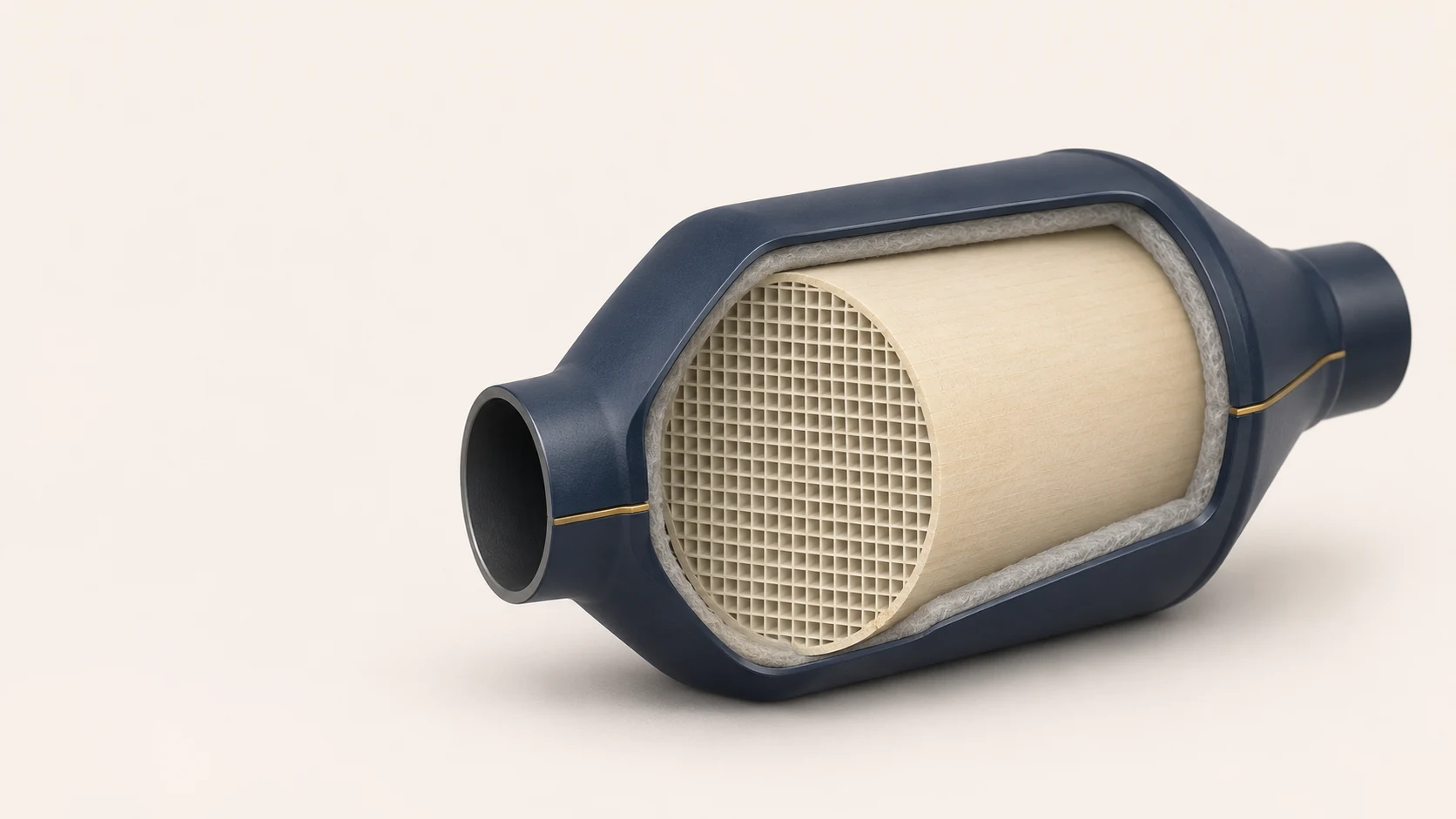
A used catalytic converter is more than a steel can. Its core, called a monolith, supports the coating that helps treat exhaust gases. For scrap yards, repair shops, and dismantlers in Japan, knowing what sits inside helps explain why units with similar shells can need different assessments. Legend Metal assesses complete used units of every common monolith catalyst type across Japan. Before sale, it helps to understand the core's material, condition, and role in metal recovery.
Key Takeaways
The monolith is the converter's channelled inner core.
Common substrates use ceramic cordierite or thin metal foil.
The washcoat carries the active precious metals.
Missing core material matters more than shell size alone.
Gross weight does not show precious metal content.
Keep units intact and ask before sorting loose material.
What is the monolith inside a catalytic converter?
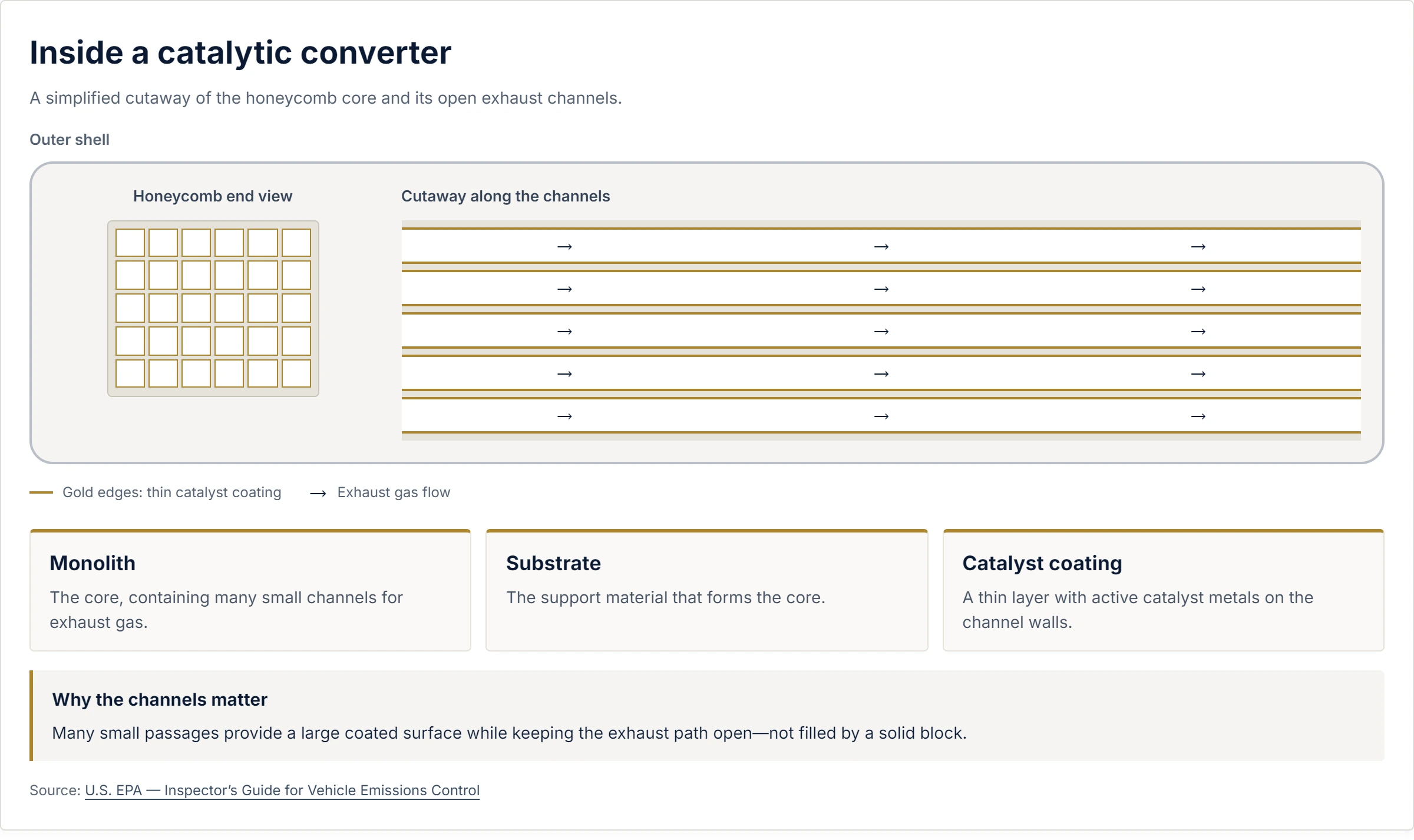
Think of the converter as a set of layers. The outer shell protects the assembly, while the substrate provides its shape and flow paths. The washcoat sits on the substrate, and the active metals sit within that coating. These parts serve different jobs, so a heavy shell does not prove that a unit holds more recoverable precious metal.
A car catalytic converter monolith may look like a honeycomb when viewed through an open pipe. However, that view shows only one face. It cannot confirm the full core's condition, its coating content, or whether material is missing deeper inside. Treat a visual check as a first screen, not a full assessment.
How do ceramic and metallic substrates differ?
Ceramic substrates commonly use cordierite, while metallic substrates use thin metal foil formed into channels. Both provide support for the catalyst coating, but they differ in structure and how they respond to handling. Ceramic can crack or chip under impact. Metal foil can bend, crush, or separate. Neither type alone tells a seller how much precious metal a used converter contains.
The review published on J-STAGE discusses automotive catalyst construction and precious metal recovery. The key distinction for sellers is between the support and its precious-metal-bearing coating. Choosing a sales route for the materials of catalytic converters requires more than naming the substrate.
Feature | Ceramic substrate | Metallic substrate |
|---|---|---|
Main support material | Commonly cordierite ceramic | Thin metal foil |
Core form | Rigid block with many small channels | Shaped foil arranged into flow channels |
Damage to watch for | Cracks, chips, and missing pieces | Crushed, bent, or separated foil |
Handling priority | Limit knocks and sudden loads | Avoid crushing or pulling apart the foil |
Value assessment | Check identity, completeness, and coating content | Check identity, completeness, and coating content |
Keep known ceramic and metallic lots separate when the buyer asks for that split. Do not break open a sound unit just to identify its substrate. Clear marks and photographs may give the assessor a useful starting point without damaging the core.
How does the washcoat carry platinum, palladium, and rhodium?
The washcoat is a thin, porous layer on the substrate that supports platinum, palladium, and rhodium in automotive catalysts. Its large surface area helps exhaust gas reach the active metals. The exact metal mix and loading vary by catalyst design, so the presence of a honeycomb does not prove that every unit contains all three metals in the same amounts.
The U.S. Environmental Protection Agency describes catalytic exhaust controls in its vehicle emissions analysis. These systems help reduce harmful exhaust emissions; the substrate supports that work rather than acting as a simple filter. A catalyst core should therefore not be judged only by whether its channels look clean or blocked.
For recycling, the key question concerns the coated material that remains available for recovery. That coating is the main reason why catalytic converters have value after vehicle use. The support, steel shell, and other parts add weight, but they do not represent the same precious metal content. That is why an assessor needs unit data or a sound analysis method, rather than a weight-only guess.
How do core condition and weight affect recycling value?
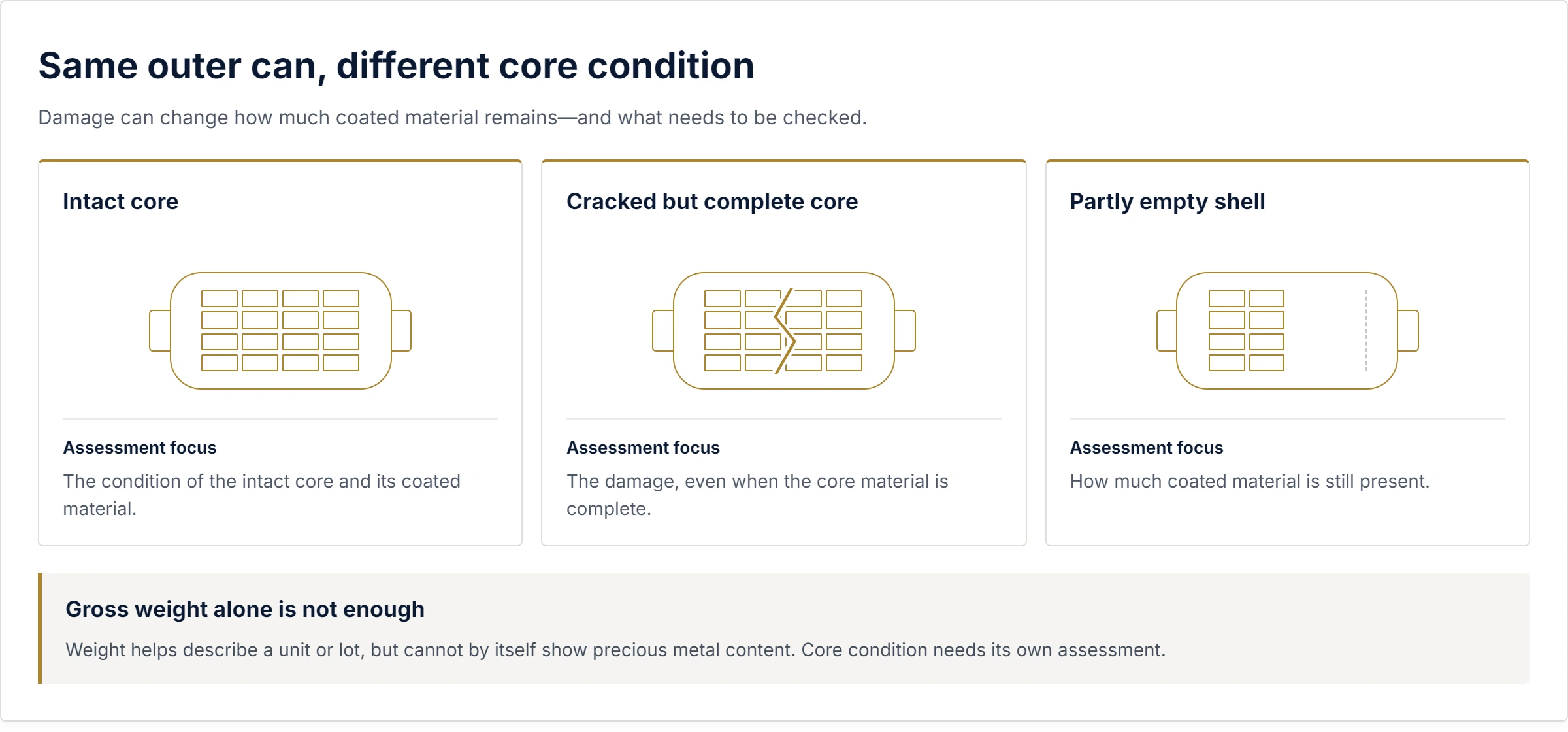
A catalytic converter monolith should be described as found, with no attempt to make damage look less serious. Record what you can see and state what remains unknown. For example, “cracked front face, loose pieces retained” gives the buyer more useful detail than “used condition.” A clear record also helps both sides discuss any difference between the first photos and the received lot.
What each condition means for assessment
Intact: Keep the unit complete and record readable part numbers. An intact face does not confirm the whole core's condition.
Cracked: State whether pieces remain in place or have fallen out. A crack alone does not show how much material has been lost.
Partly missing: Show the empty area clearly. Do not present a partly empty shell as a complete unit.
Clogged: Report blocked channels or deposits. Deposits are not proof of higher precious metal content.
Loose or mixed: Keep known origins and lot records. Ask the buyer how to contain and submit the material.
Use weight with a clear label: complete unit, core material, or mixed lot. Pipes and shells can make one unit heavier without showing more recoverable metal. Moisture, dirt, and other foreign material also need to be considered during lot preparation. Ask how the assessor defines the submitted weight and the weight used for settlement.
The useful comparison is not simply “heavy versus light.” It is known identity, material type, completeness, and measured content where analysis applies. Keep those facts together so the buyer can choose a suitable assessment route.
When should you sell by unit or by laboratory analysis?
Selling by unit suits complete, identifiable converters, while laboratory analysis can suit mixed, bulk, or already processed catalyst material. The right route depends on what the seller holds and how clearly the material can be identified. Legend Metal assesses whole units using details such as part number, maker, and model, and offers analysis-based assessment for suitable catalyst lots.
For a complete unit, start with clear photos of the shell, marks, pipe ends, and any visible damage. For an analysis lot, ask how sampling, testing, and reporting will work before shipment. A sample needs to represent the agreed lot if its result will guide the assessment. Also confirm how the buyer will record incoming material and handle any disputed findings.
Choose a unit discussion first: Complete converters with readable marks and a clear source.
Ask about analysis: Mixed lots, bulk core material, or material already removed from shells.
Request advice before changing anything: Unknown units, damaged cores, and mixed substrate types.
Do not cut open a complete converter just to seek an analysis quote. First ask whether unit identification can support an assessment. For a wider overview of shells, cores and unit designs, see catalytic converter structure and types.
How should workshops handle and store used converters?
Workshops should keep used converters secure, dry, and protected from knocks while preserving their marks and lot records. The aim is to avoid losing core material before assessment. Handle only parts your business has lawful authority to hold or sell, and use trained staff and suitable procedures when working around exhaust systems or loose catalyst material.
Let units cool: Follow workshop safety procedures before moving or packing exhaust parts.
Avoid impact: Do not throw units into bins or stack heavy parts on exposed pipe ends.
Keep lots traceable: Record the source, count, visible condition, and available part numbers.
Protect loose material: Use suitable closed containers agreed with the buyer. Do not blow dust out with compressed air.
Leave cleaning to an agreed process: Do not wash, shake out, or strip cores before asking the assessor.
Good handling protects evidence as well as material. Take photos before dispatch and keep the packing list with the lot record. Sellers assessing the metals contained in catalytic converters should agree on preparation and sampling before sending loose cores.
Summary
The automotive exhaust catalyst substrate supports the coating that carries active metals; it is not a direct measure of recycling value. Check core type, preserve complete units, and report damage with care. Legend Metal offers unit-based and analysis-based routes for business sellers. Clear records and careful handling make assessment discussions more useful. To see which precious metals the coating can hold, read metals found inside catalytic converters.