
Metals Found Inside Catalytic Converters

Written by:
LEGEND METAL
Legend Metal is a Japan-based recycling company specializing in the purchasing, analysis, and recovery of catalytic converters, precious metals, automotive components, batteries, and electronic scrap. Since 2014, the company has been delivering accurate valuations, transparent service, and reliable support to clients across Japan and internationally.
The metals inside an automotive catalytic converter help turn harmful exhaust gases into less harmful emissions. They also give a used converter much of its recycling value. For workshops, vehicle dismantlers, suppliers, and recyclers, knowing what sits inside each unit can support better sorting and more accurate assessment. Legend Metal evaluates valuable metals in catalytic converters through unit data, part details, market indicators, and, where needed, laboratory analysis.
Key Takeaways
Platinum, palladium, and rhodium are the main precious metals found in automotive catalysts.
The visible shell does not reveal the actual precious metal content.
Metal loading differs by vehicle, fuel type, converter design, age, and emissions needs.
Ceramic and metallic substrates support the active catalyst coating.
Unit identification works well for intact, recognised converters.
Laboratory analysis gives stronger data for mixed or processed material.
Careful sorting, records, and handling can improve valuation accuracy.
Which metals are found inside catalytic converters?
Most automotive converters contain platinum group metals, or PGMs. The three main PGMs are platinum, palladium, and rhodium.
These metals sit in a thin active layer on the converter's internal substrate. They are not present as large, easy-to-remove pieces. Instead, very small amounts are spread across a wide surface so exhaust gas can contact the catalyst.
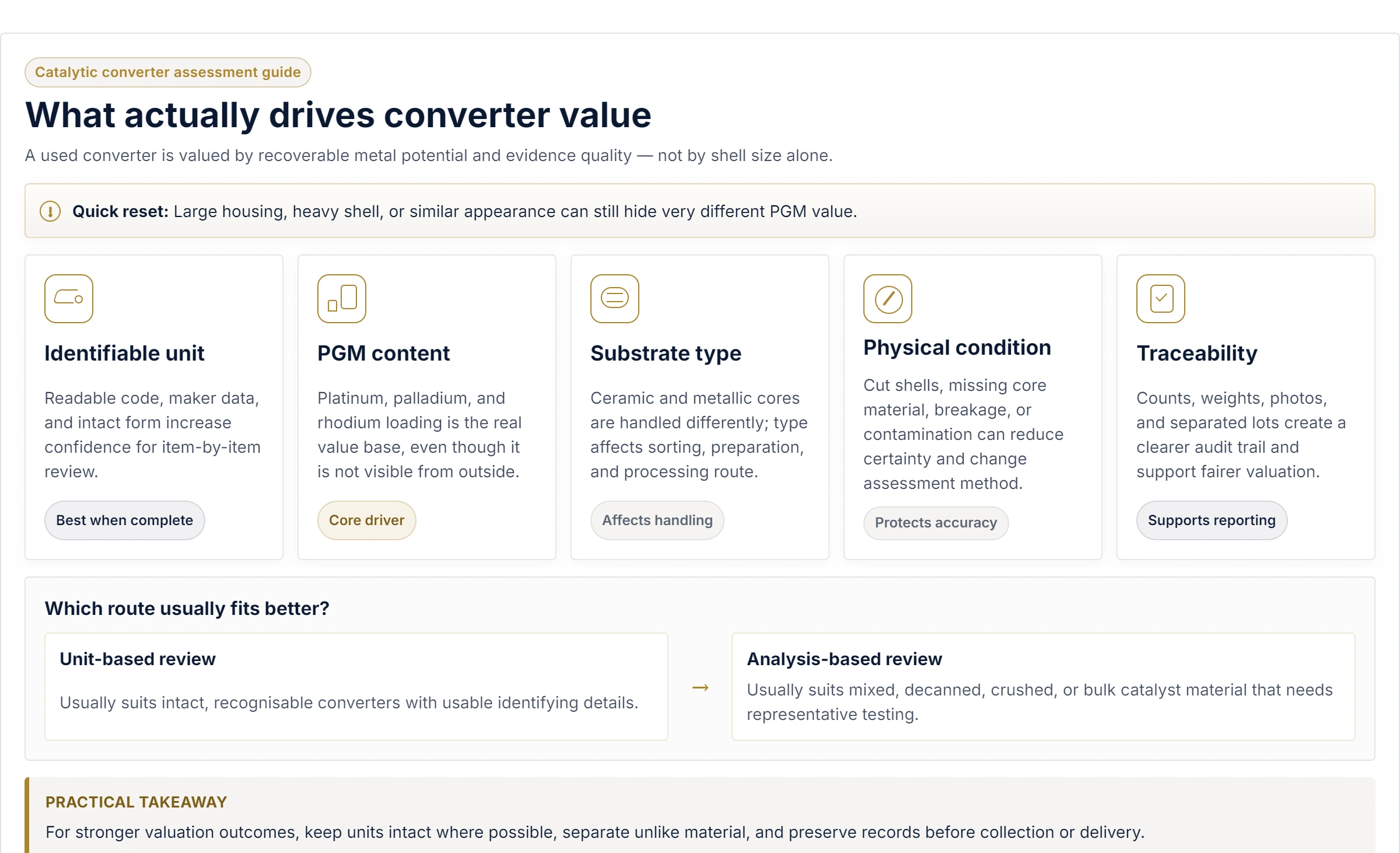
The exact mix varies. A converter may use more than one PGM, and two units that look alike can have different metal loadings. Vehicle type, engine design, fuel, emissions controls, and production period can all matter. For that reason, an outer shell alone is not enough for a sound assessment.
The US Department of Energy describes platinum, palladium, and rhodium as key materials in catalytic applications and reviews their role within the PGM catalyst supply chain. Their useful chemical behaviour and limited supply make recovery from used catalysts important.
What does platinum do in an automotive catalyst?
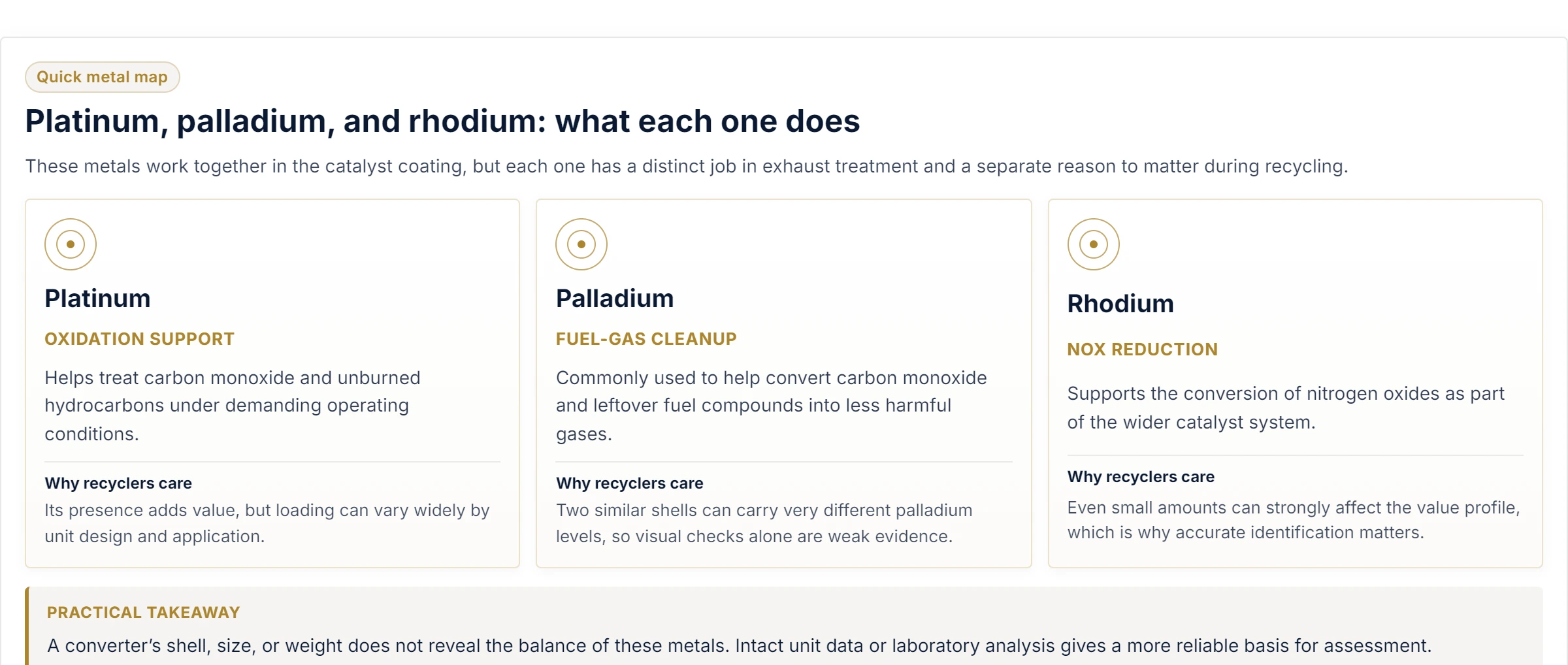
Platinum supports reactions that treat carbon monoxide and unburned hydrocarbons in exhaust gas. It can work under demanding heat and chemical conditions.
The term automotive catalyst platinum refers to platinum used in the active coating of an emissions catalyst. Its presence does not mean every converter has the same amount. Loading depends on the design and purpose of the unit.
A search for platinum catalyst automotive may suggest that platinum is the only metal that matters. In practice, it forms part of a wider catalyst system. Palladium and rhodium may be present beside it, while the substrate and washcoat help expose the active metals to exhaust gas.
What does palladium do inside the converter?
Palladium helps convert carbon monoxide and unburned fuel compounds into less harmful gases. It is widely associated with automotive emissions catalysts.
Automotive catalyst palladium loading can differ from one vehicle application to another. A valuer must therefore avoid treating every converter of the same size as equal. Identification data or representative analysis gives a firmer basis.
Palladium cannot be judged by colour or shell weight. It remains within the coated internal material. Even after a converter has reached the end of its service life, part of that material may still be suitable for specialist recovery.
Why is rhodium used in catalytic converters?
Rhodium supports the reduction of nitrogen oxides in exhaust gas. It works with platinum and palladium as part of a controlled catalyst system.
A unit can contain rhodium in a different proportion from its other PGMs. That proportion is one reason why simple weight-based estimates may miss key differences between converters.
The three metals also have separate recovery and refining paths within the wider recycling process. Accurate identification matters before material moves into processing, sampling, analysis, and final recovery.
What other materials make up a catalytic converter?
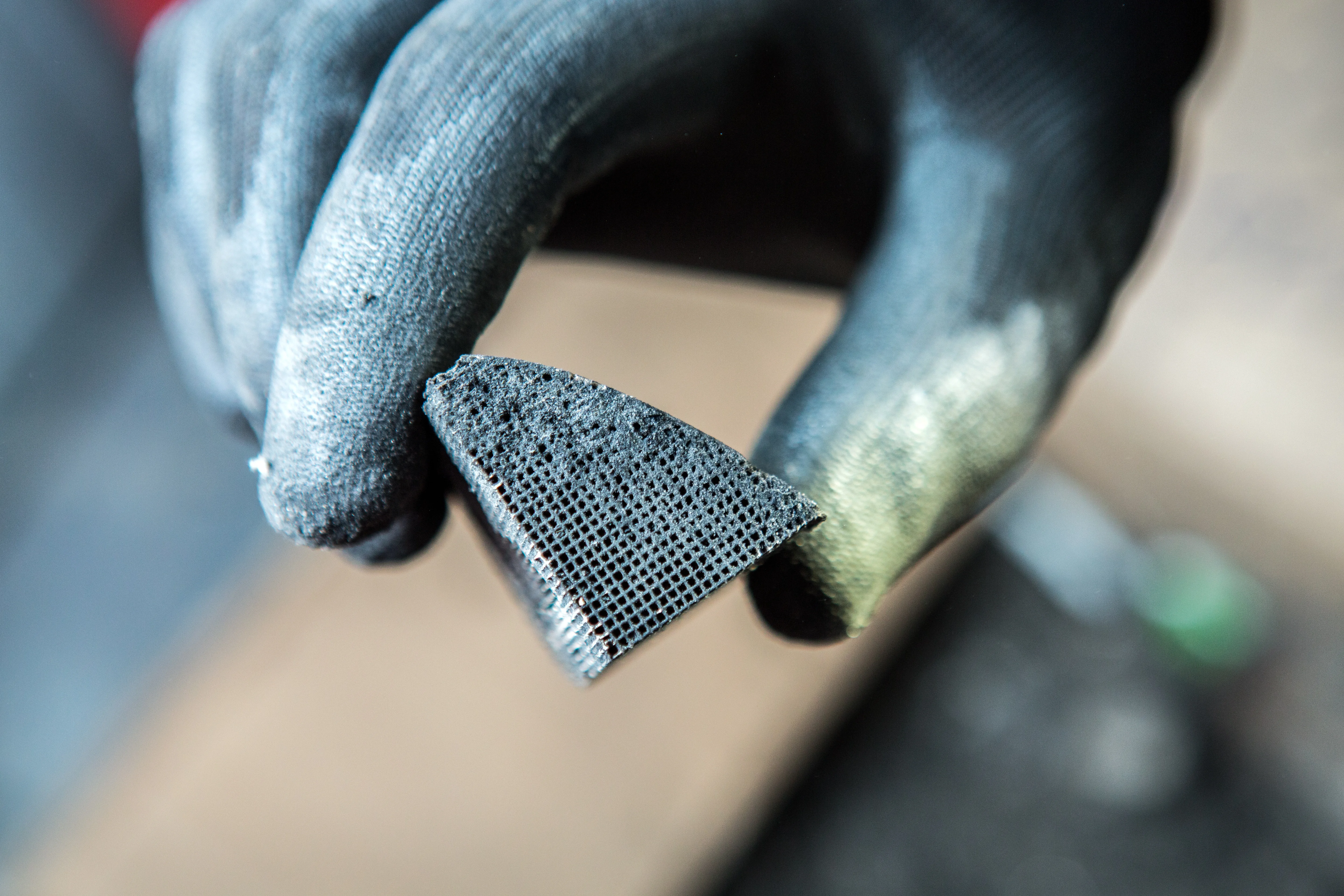
A converter includes more than precious metals. Its main parts normally include an outer shell, an internal substrate, a surface coating, and support or sealing material.
The shell protects the internal structure and connects the unit to the exhaust system. Inside it, a honeycomb-like substrate creates a large contact area without blocking normal gas flow. A porous washcoat covers that substrate and carries the active catalyst material.
The phrase materials of catalytic converters therefore covers several layers with different jobs. Only looking at gross weight can give a poor picture of recoverable PGM content.
What does each converter material do?
Each material supports gas flow, heat control, structural strength, or catalytic activity. The following table shows how the main parts fit together.
Converter material or part | Main purpose | Why it matters during assessment |
|---|---|---|
Steel outer shell | Protects the core and connects to the exhaust | Part markings and condition can help identify an intact unit |
Ceramic substrate | Provides a honeycomb surface for the active coating | Breakage or missing material can affect the assessed lot |
Metallic substrate | Provides a thin, heat-resistant support structure | It requires suitable sorting and processing |
Washcoat | Creates a porous surface that carries catalyst material | Its design affects how PGMs are spread through the core |
Platinum, palladium, and rhodium | Support the main emissions-control reactions | Their measured or expected content is central to recycling value |
Support and sealing material | Holds the core in place and protects it from vibration | It adds weight but does not represent PGM content |
What role does cerium play in the catalyst system?
Cerium can form part of the washcoat system rather than the main PGM group. It supports the chemical conditions needed for effective catalyst action.
A report from the US Geological Survey examines the potential recovery of cerium from automotive catalysts. This shows that used converter material can contain other technically useful elements beyond platinum, palladium, and rhodium.
However, cerium and PGMs should not be treated as if they have the same role. PGMs provide the core precious metal basis for common converter valuation, while the washcoat supports their function and distribution.
Are all substrates made from ceramic?
No. Many converters use ceramic honeycomb cores, while others use metallic substrates.
The substrate type affects how the unit is handled and processed. Ceramic cores can crack or lose loose material after impact. Metallic cores have a different structure and need correct classification. Neither substrate type reveals PGM loading by itself.
A complete unit with a readable code may be suitable for item-by-item assessment. Loose ceramic, crushed cores, metallic foil, or blended catalyst material usually needs another method.
How do PGM content and substrate design affect recycling value?
Recycling value depends on the recoverable metal content, not on shell size alone. Substrate design affects how the active coating is carried and how a sample must be prepared.
The metals contained in catalytic converters can be assessed through controlled sampling and laboratory measurement when a lot is mixed, decanned, crushed, or processed. This helps connect payment to measured PGM content rather than visual assumptions.
A large unit is not always richer than a small one. Likewise, a heavy shell does not prove high precious metal loading. Some of the total weight comes from steel, support material, and the substrate itself.
Why can two similar converters have different values?
Two similar-looking units may come from different vehicle applications or production runs. Their PGM mixes and loadings may therefore differ.
Part numbers and manufacturer markings can help separate these units. Vehicle model information may add context. However, physical condition also matters. A cut shell, missing core, replaced internal material, or unreadable code can reduce confidence in a unit-based assessment.
Data-led review lowers the risk of grouping unlike items together. It also creates a clearer record for the supplier and recycling company.
Does more substrate mean more precious metal?
Not always. A larger substrate provides more surface area, but its PGM concentration may be lower or different.
Converter design aims to meet the needs of a specific emissions system. The maker can vary cell structure, coating, substrate volume, and active metal loading. It is therefore unsafe to use core size as a direct measure of value.
This point is especially important for truck, commercial vehicle, and industrial vehicle catalysts. Their units can be large and difficult to move, yet they still need item data or analysis for a fair assessment.
When should a converter be valued by unit or by analysis?
Unit-based assessment suits intact converters that can be identified with reliable codes or records. Analysis suits mixed, bulk, decanned, or pre-processed catalyst material.
Neither route is automatically better in every case. The right method depends on the material's form, lot size, condition, and traceability. A clear intake review should come first.
Which assessment method fits each material type?
Intact and identifiable items often fit a unit database, while blended material needs representative testing. This table compares the two routes.
Assessment factor | Unit-based assessment | Analysis-based assessment |
|---|---|---|
Typical material | Complete, unprocessed converter units | Mixed, decanned, crushed, or bulk catalyst material |
Main data | Part number, maker, model, condition, and internal records | Lot weight, sampling data, laboratory results, and metal content |
Key strength | Fast sorting of known and intact units | Direct measurement of a prepared, representative sample |
Main concern | Unreadable codes, missing cores, or altered units | Poor mixing, weak sampling, moisture, or contamination |
Useful records | Item list, images, source details, and unit count | Lot history, weights, sample records, and analysis report |
How does unit-based converter assessment work?
Unit assessment uses identifying details to match each converter with known data. It works best when the shell, code, and internal core remain intact.
Staff may record the part number, manufacturer, vehicle link, physical condition, and unit count. Internal data and relevant market indicators then support the assessment. Clear photos and sorted batches can make intake faster.
This method suits workshops, dismantlers, suppliers, and recycling firms that collect complete converters. It also gives each identifiable unit a clear place in the transaction record.
How does laboratory analysis improve accuracy?
Laboratory analysis measures the PGM content of a prepared sample. It is useful when individual unit identification no longer reflects the lot.
The process depends on sound lot preparation. Mixed material needs thorough blending so a sample can represent the wider batch. Weight records, sample control, measurement, and reporting then form an auditable data trail.
Analysis is not simply a test added at the end. The quality of sorting, preparation, and sampling affects the usefulness of the result. A detailed report gives both parties a clearer basis for review.
How can businesses prepare used converters for accurate assessment?
Businesses should sort units, protect identification marks, record quantities, and keep loose material separate. Good records reduce uncertainty before collection or delivery.
Keep complete units intact. Avoid unnecessary cutting or core removal when the units will be assessed by part number.
Separate damaged material. Place loose ceramic, broken cores, and metallic substrate in suitable containers.
Group similar items. Keep passenger vehicle, commercial vehicle, unknown, and processed material in separate lots.
Record key details. Note unit counts, source, condition, and any available part information.
Take clear images. Photograph codes, shells, damage, and the overall lot before transport.
Prevent material loss. Use closed, stable containers for dust, fragments, or decanned material.
Discuss the assessment route early. Confirm whether the batch will use unit data or laboratory analysis.
These steps do not change the metal content. They do, however, preserve information and help the receiving recycler choose a suitable assessment method.
Why are sorting and traceability important?
Sorting keeps unlike material from being valued as one uniform batch. Traceability links the received material to records, weights, assessment data, and processing steps.
A mixed load can contain complete units, empty shells, damaged cores, and unrelated exhaust parts. If these items remain together, gross weight offers little useful detail. Separation gives each category a clearer treatment route.
For business suppliers, traceable records can also support internal stock control. They make it easier to compare the dispatched lot with the intake report.
Why should catalyst dust and fragments be contained?
Dust and broken substrate should be kept in stable, closed containers. This helps prevent material loss and supports safer handling.
Loose catalyst material may hold part of the lot's active coating. If it spills during storage or transport, the physical lot changes before sampling. Clean, sealed containers help preserve lot integrity.
Staff should also avoid mixing converter material with general metal scrap. Steel shells, oxygen sensors, wiring, and unrelated components need separate sorting where possible.
Why does accurate catalyst recycling matter?
Accurate recycling supports the recovery of finite materials and gives suppliers a clearer view of how their used converters are assessed. It also reduces reliance on guesswork.
Used converters should not be treated as ordinary steel scrap. Their key material sits inside the coated substrate, and specialist processing is needed to recover it. A responsible route includes controlled receipt, sorting, assessment, processing, and transfer through suitable recycling channels.
For a business, transparency is just as important as speed. A clear method explains what was received, how it was classified, which data informed the assessment, and when analysis was required.
What should a business ask a catalytic converter recycler?
Ask how units are identified, how mixed lots are sampled, and what records are provided. The answers should be clear enough for staff to review later.
Will intact units be assessed one by one?
How are unreadable, damaged, or incomplete units handled?
When does the recycler recommend laboratory analysis?
How are mixed lots prepared before sampling?
What weights, photos, item lists, or reports will be issued?
How is material tracked after collection?
What packaging is needed for broken or decanned catalyst material?
Legend Metal uses unit information and analytical data according to the type of catalyst supplied. For mixed and processed lots, its catalytic converter precious metals service focuses on measurement, reporting, and a clear basis for valuation.
Summary
Platinum, palladium, and rhodium are the main precious metals recovered from automotive catalytic converters. They sit within a coated ceramic or metallic substrate, not as visible pieces inside the shell.
Converter size and gross weight cannot show PGM content on their own. Intact, recognised units may suit item-based assessment. Mixed, decanned, or processed catalyst material often needs careful preparation, representative sampling, and laboratory analysis.
Good sorting and records help preserve both material and data. Legend Metal supports business suppliers with unit assessment, analytical evaluation, clear reporting, and responsible recycling routes based on the form and condition of each lot.