
DPF vs DPD: What’s the Difference?

Written by:
LEGEND METAL
Legend Metal is a Japan-based recycling company specializing in the purchasing, analysis, and recovery of catalytic converters, precious metals, automotive components, batteries, and electronic scrap. Since 2014, the company has been delivering accurate valuations, transparent service, and reliable support to clients across Japan and internationally.
DPF and DPD often describe the same basic type of diesel exhaust system, yet the terms can cause real confusion. This is common among Japanese truck owners, workshop teams, vehicle dismantlers, and parts suppliers. Put simply, DPF is the general technical term for a diesel particulate filter, while DPD is a name used by some vehicle manufacturers for their diesel particulate reduction system. Knowing what is DPF helps teams identify parts, read warning lights, plan maintenance, and discuss replacement or recycling with greater accuracy.
Key Takeaways
DPF means diesel particulate filter.
DPD is a manufacturer-specific name used on some diesel vehicles.
Both terms relate to the capture and removal of soot from exhaust gas.
A DPF or DPD may need regeneration when soot builds up.
Warning lights and regeneration steps vary by vehicle model.
Correct part identification matters during repair, replacement, and recycling.
Used truck exhaust units should be assessed by type, condition, and identifying data.
What is the basic difference between DPF and DPD?
The main difference is naming, not the core purpose. DPF is a broad technical term, while DPD is a label that certain manufacturers use for a diesel particulate cleaning system.
DPF stands for diesel particulate filter. It refers to a filter in the exhaust system that traps particulate matter, including soot produced during diesel combustion. The captured material must then be removed through a process called regeneration.
DPD commonly means diesel particulate diffuser or diesel particulate defuser, depending on how a manufacturer presents the term in its documents. In practical workshop use, DPD usually describes a system that captures diesel particles and burns accumulated soot. Its purpose is therefore close to that of a DPF.
The difference between DPD and DPF is most useful when reading a dashboard message, ordering a replacement unit, checking a workshop manual, or identifying an exhaust part for recycling. A mechanic may use the broad term DPF in conversation, while the vehicle display and service manual use DPD.
Why do Japanese trucks use different names?
Japanese vehicle makers may use their own product names for diesel exhaust systems. These labels help identify a maker's system, controls, warning messages, and regeneration procedures.
This does not mean each named system has a completely different environmental purpose. The basic task remains the capture and treatment of particulate matter in diesel exhaust. However, system design can vary by maker, model, engine, and model year.
For that reason, service teams should not rely on the name alone. They should confirm the vehicle identification, part number, engine type, warning information, and service instructions. This is especially important when a fleet includes trucks from several manufacturers.
How does a diesel particulate filter work?
A diesel particulate filter captures soot as exhaust gas passes through its porous filter material. When enough soot collects, the system raises the temperature or uses another controlled process to burn much of it away.
According to DieselNet, particulate filters remove diesel particulate matter from exhaust through physical filtration. Filter designs and materials can differ, but the shared principle is that gas passes through while particles remain in the filter structure.
This filtration helps reduce particulate emissions. Yet the filter cannot hold soot without limit. The vehicle must carry out regeneration, either during normal driving or through a controlled procedure.
What happens during regeneration?
Regeneration burns accumulated soot at a high temperature. Depending on the vehicle, it may happen automatically, during sustained driving, or after the driver starts a parked regeneration cycle.
Automatic regeneration may take place without major driver input when operating conditions allow it. Other vehicles may ask the driver to keep driving, change the operating pattern, or stop safely and begin manual regeneration.
A warning lamp does not always mean the filter has failed. It may mean that soot has reached a level at which regeneration is needed. However, ignoring repeated warnings can allow further buildup and may lead to reduced engine performance or workshop attention.
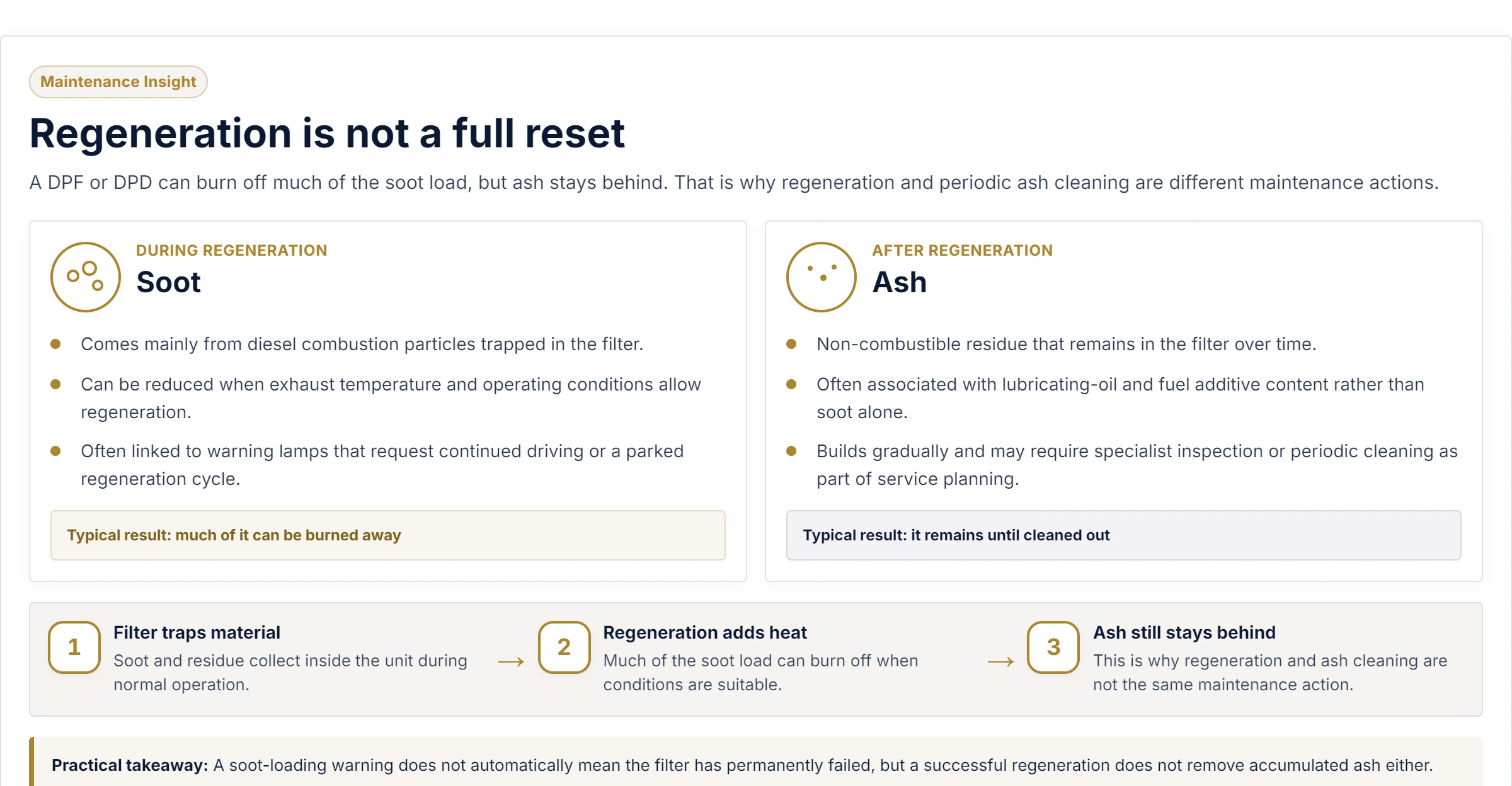
The UK government guidance on diesel particulate filters notes that filters need suitable operating conditions to regenerate. Frequent short trips at low speed can make this process harder because the exhaust may not reach the required temperature.
What do common DPF and DPD terms mean?
The terms below describe the same broad emissions-control area, but they are not always interchangeable in parts records or repair documents. This table gives a practical comparison.
Term | General meaning | Where it appears | Practical point |
|---|---|---|---|
DPF | Diesel particulate filter | General technical documents, parts listings, inspections, and workshop discussions | Use the vehicle and part data to confirm the exact unit |
DPD | A manufacturer-specific name for a diesel particulate treatment system | Some Japanese truck dashboards, manuals, switches, and service records | Follow the maker's instructions for warnings and regeneration |
Regeneration | The process used to burn collected soot | Driver manuals, scan tools, warning messages, and maintenance records | Conditions and steps vary by model |
Ash cleaning | Removal of non-combustible residue that remains after soot burns | Scheduled service and specialist filter cleaning | Regeneration does not remove all ash |
What is DPD for trucks?
What is DPD for trucks is mainly a question about manufacturer terminology. On relevant trucks, DPD refers to the system that collects particulate matter and manages soot removal through regeneration.
Drivers may see a DPD lamp, a regeneration request, or a switch marked with system-specific wording. These signals should be read with the manual for that exact truck. A process that is correct for one model may not match another model.
The term truck DPD is also used in parts handling and recycling discussions. Even then, the label alone does not provide enough detail for a sound assessment. The complete unit, visible codes, maker, model, engine application, condition, and any signs of alteration can all help clarify what has been supplied.
Is DPD simply another word for DPF?
In everyday conversation, people often use DPD and DPF for systems with the same basic role. For technical work, however, it is safer to keep the vehicle maker's original term.
Using the correct name makes it easier to find the right warning-light procedure and parts information. It also reduces mistakes when staff speak with a dealer, repair shop, supplier, dismantler, or recycling company.
For example, a driver might report a DPF warning even though the dashboard calls it DPD. The workshop will likely understand the issue, but recording the exact dashboard message gives the technician better information.
What is a truck DPF?
What is truck DPF can be answered simply: it is a diesel particulate filter designed for a truck's exhaust system. It captures soot and forms part of the vehicle's emissions-control equipment.
Truck units can be larger and heavier than those fitted to passenger cars. Their shape, housing, connections, sensors, and internal structure may also vary. Commercial duty cycles add another important factor. A long-distance truck may have different regeneration conditions from a vehicle used for short urban routes, local deliveries, or frequent idling.
These differences matter during diagnosis. A warning may relate to soot loading, but the system also depends on sensors, temperature conditions, engine operation, and control logic. Replacing the filter without confirming the cause may fail to solve the underlying problem.
How do driving conditions affect a truck filter?
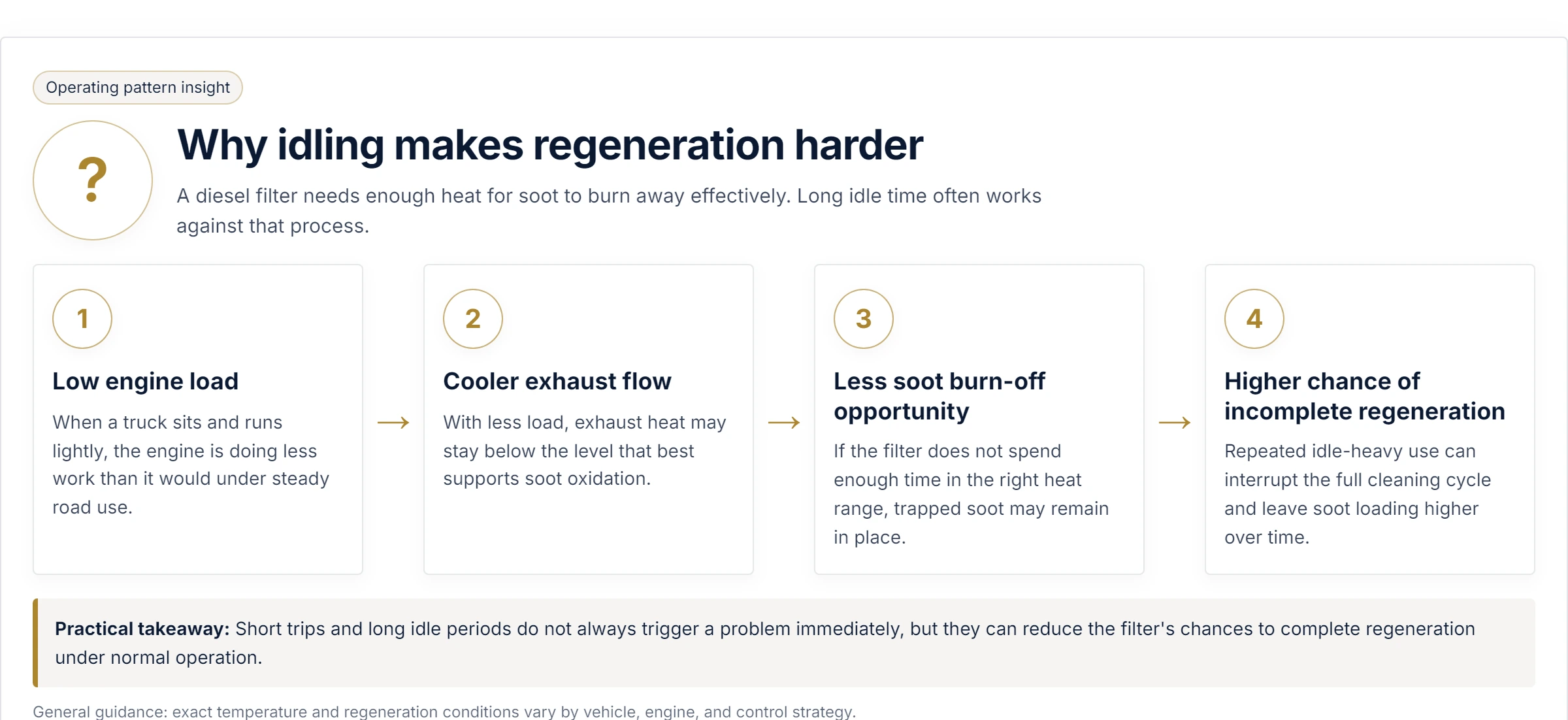
Driving conditions affect whether the exhaust reaches and maintains conditions that support regeneration. Repeated low-speed trips, long idle periods, and interrupted cycles may leave more soot in the filter.
A truck that travels longer distances under steady load may have more chances to complete automatic regeneration. Even so, no single driving pattern guarantees that a filter will remain trouble-free. Vehicle condition and manufacturer requirements still matter.
Fleet managers can help by recording warning events, regeneration frequency, routes, mileage, and workshop findings. Clear records make repeated faults easier to spot. They also give maintenance staff useful context before parts are removed.
How can you tell whether a warning relates to DPF or DPD?
Check the exact dashboard symbol, message, and vehicle manual first. The maker's wording will show whether the system is called DPF, DPD, or another product name.
Do not judge the problem from the lamp alone. Some warnings request regeneration, while others may signal a more serious condition or a separate engine issue. The color, flashing pattern, accompanying lamps, and vehicle behavior can all matter.
What should a driver do when the warning appears?
The driver should follow the manual for that vehicle and report the warning clearly. If the manual calls for parked regeneration, the truck must be placed in a suitable safe area before the process begins.
Note the exact warning symbol and message.
Check whether the light is steady or flashing.
Record any loss of power or unusual engine behavior.
Read the maker's regeneration instructions.
Use a safe location if parked regeneration is required.
Contact a qualified workshop if the warning remains or returns.
Drivers should not remove, open, wash, or modify an exhaust unit based only on a dashboard warning. A trained workshop can check fault data and determine whether regeneration, cleaning, repair, or replacement is suitable.
Which details should a workshop or fleet record?
A useful record should connect the warning to the truck, operating conditions, and work performed. This table shows the main details that help with diagnosis and later parts handling.
Detail to record | Why it matters | Example source |
|---|---|---|
Truck maker and model | Confirms the system family and correct service information | Vehicle records |
Engine and model year | Helps separate units that look similar but use different controls | Registration and workshop data |
Exact warning message | Shows whether the truck requests regeneration or service | Dashboard display |
Fault information | Helps technicians assess the whole system rather than one component | Diagnostic equipment |
Recent driving pattern | Provides context about possible regeneration conditions | Driver or fleet log |
Part number and visible codes | Supports part identification, replacement, and recycling assessment | Removed unit |
Why does the correct term matter for maintenance?
Correct terminology helps staff find the right manual, procedure, and component. It also makes communication clearer across drivers, fleet managers, workshops, suppliers, and recyclers.
Confusion can begin with a simple work order. If the driver says "filter light" but the technician records an unrelated exhaust part, time may be lost checking the wrong component. Writing down the exact DPF or DPD message reduces that risk.
Part identification matters as well. An exhaust assembly can include a particulate filter, catalyst sections, sensors, pipes, and housings. These parts may sit close together or form a combined unit. For a clear explanation of the related emissions component, see this guide to how a catalytic converter works.
Are a DPF and catalytic converter the same part?
No. A particulate filter captures solid particles, while a catalytic converter supports chemical reactions that treat certain exhaust pollutants.
However, modern diesel exhaust assemblies may place these functions near each other or combine them within a larger system. That is why a complete visual check and part-code review are more reliable than a broad label such as "exhaust box."
The internal materials can also differ by component and design. Recycling staff need an accurate description of what was removed, whether the unit remains complete, and whether it has been cut, emptied, cleaned, or damaged.
Why does terminology matter when replacing or recycling a unit?
Clear terminology supports accurate sorting, assessment, and traceable handling. It helps the receiving company understand whether the material is a complete truck exhaust unit, a loose filter, a catalyst section, or a mixed lot.
For used commercial vehicle parts, photos and identification data can save time before collection or delivery. Useful images include the complete unit, stamped numbers, labels, inlet and outlet ends, sensor ports, and any visible damage.
Businesses should avoid mixing unidentified exhaust parts with general metal scrap. Separate storage preserves labels and makes inspection easier. It also reduces the chance of damaging ceramic material or losing related sections before assessment.
What information helps with a recycling assessment?
The most helpful information identifies the unit and shows its current condition. A recycler may ask for part numbers, vehicle details, quantity, photos, weight, storage location, and notes about prior processing.
Keep each unit intact unless an agreed process says otherwise.
Photograph all visible codes before transport.
Separate truck units from passenger vehicle parts.
State whether items are complete, cut, cleaned, or damaged.
Record the number of units in each lot.
Use stable packaging that suits the size and weight.
Share collection and site-access details in advance.
How should businesses prepare used truck units for collection?
Businesses should identify, separate, record, and store the units before collection. Good preparation supports safer handling and a clearer assessment.
Large truck exhaust parts may be awkward to move due to their size and shape. Place them on stable supports or suitable pallets, prevent rolling, and keep access routes clear. Staff should use handling methods that fit the load and workplace rules.
A mixed shipment should include a simple item list. Group similar units where possible, but do not remove identification plates or alter the housings merely to make the lot look uniform. Original condition often provides useful evidence during inspection.
When discussing truck DPF recycling, share the expected quantity and whether the material comes from maintenance, fleet replacement, dismantling, or stored inventory. This gives the receiving team a better basis for planning collection and review.
Summary
DPF is the broad term for a diesel particulate filter. DPD is a manufacturer-specific name used on some trucks for a system with a similar core purpose: capturing particulate matter and managing soot through regeneration.
The right term matters because dashboard messages, regeneration steps, diagnostic records, replacement parts, and recycling documents may follow the maker's language. Drivers should read the vehicle manual, while workshops should confirm model data, fault information, and part numbers before deciding what work is needed.
Once a unit reaches the end of its service life, careful identification remains important. Complete photos, visible codes, condition notes, and clear lot records support a fair and transparent review. Legend Metal can assist business customers with the assessment, collection, and responsible recycling of used truck exhaust components.