
What Is a Catalytic Converter?
Meaning, Role & Location

Written by:
LEGEND METAL
Legend Metal is a Japan-based recycling company specializing in the purchasing, analysis, and recovery of catalytic converters, precious metals, automotive components, batteries, and electronic scrap. Since 2014, the company has been delivering accurate valuations, transparent service, and reliable support to clients across Japan and internationally.
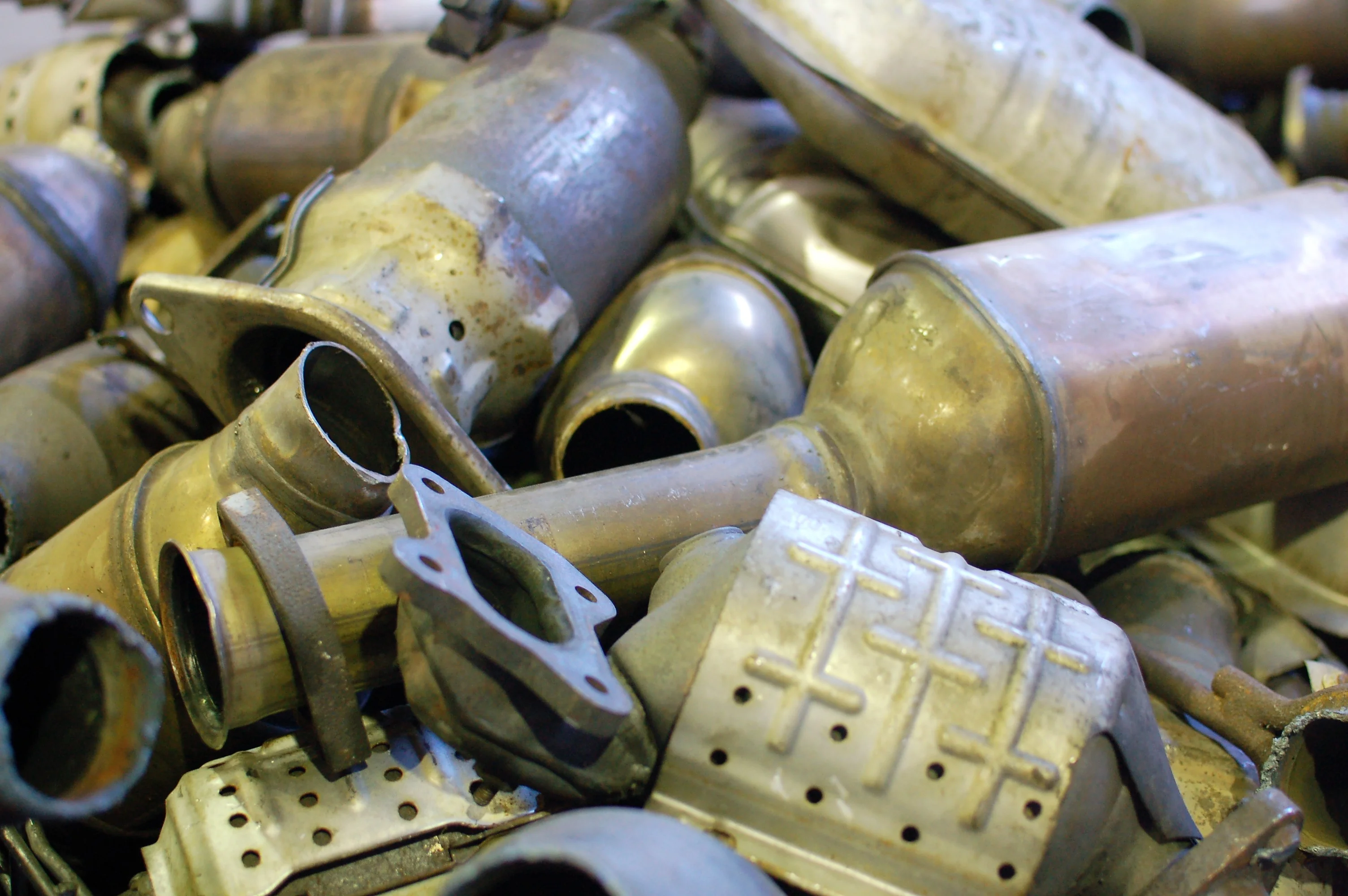
If you have ever asked what is a catalytic converter, the short answer is simple: it is an emissions-control part fitted to a vehicle's exhaust system. It changes several harmful exhaust gases into less harmful substances before they leave the tailpipe. Understanding this part can help vehicle owners, repair shops, dismantlers, and recyclers make sound choices about inspection, replacement, sale, and responsible recycling.
Key Takeaways
• The converter forms part of a vehicle's exhaust and emissions system.
• It changes certain harmful gases through chemical reactions.
• Most units sit beneath the vehicle or close to the engine.
• Design, size, and placement differ by vehicle and engine type.
• Platinum group metals help the internal reactions take place.
• Part numbers and condition matter before sale or recycling.
• Business sellers should keep units identifiable and document their source.
What does a converter do?
It treats exhaust gases before they leave the vehicle. Its main role is to reduce certain pollutants produced when an engine burns fuel.
The plain-English catalytic converter meaning is therefore an exhaust part that supports cleaner vehicle emissions. It does not trap every pollutant like a basic filter. Instead, its internal materials help chemical reactions occur as hot exhaust passes through the unit.
These reactions change certain gases into less harmful forms. According to the US EPA, motor vehicles contribute to air pollution through emissions associated with transportation. Emissions-control parts help reduce the effect of pollutants released during vehicle use.
The converter works without supplying power to the wheels. It also does not replace the engine, exhaust pipe, silencer, sensors, or other emissions parts. Each part has its own job, while the full system must work as one connected assembly.
Why is the word catalytic used?
The term refers to a catalyst, which helps a chemical reaction happen without serving as the vehicle's fuel. Inside the unit, catalytic materials help exhaust compounds react when operating conditions are suitable.
The basic catalytic converter mechanism depends on heat, exhaust flow, the internal support structure, and catalytic materials. The vehicle's engine controls also affect the gases entering the unit. A fault elsewhere in the vehicle can therefore reduce converter performance or damage it over time.
Platinum, palladium, and rhodium are commonly grouped as platinum group metals, or PGMs. These metals have value after a unit reaches the end of its useful life. However, a used unit's value cannot be judged from its outer shell alone. Identification, type, internal condition, and material analysis may all matter.
Where is the emissions unit located?
It is located in the exhaust path between the engine and the tailpipe. The exact position depends on the vehicle's design, engine layout, and emissions system.
Many vehicles have a unit under the floor, where it looks like a widened metal section in the exhaust pipe. Others place one close to the engine so it can heat up sooner. A vehicle may also have more than one unit.
On some layouts, the part sits near the exhaust manifold. On others, pipes connect it to the engine at the front and the rest of the exhaust system at the rear. Heat shields may cover part of the shell, which can make visual identification less clear.
An oxygen sensor may appear before or after the converter. These sensors are separate components. They help the vehicle monitor exhaust conditions, but they are not the converter itself.
How can you identify it safely?
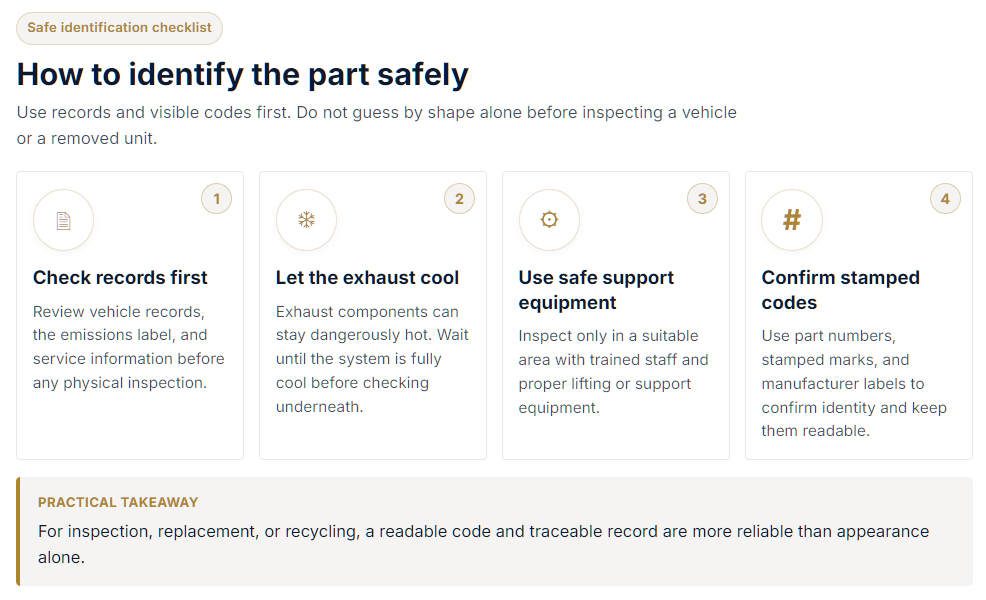
Start with vehicle records, the emissions label, and the manufacturer's service information. Do not rely only on shape because exhaust parts can look similar.
The US EPA guidance on vehicle emissions labels explains that label placement can vary, with common locations including the engine compartment. Vehicle-specific records can help confirm the emissions family and original configuration.
If a physical check is needed, let the exhaust cool fully and use a suitable inspection area. Exhaust parts can become very hot. A business should use trained staff, safe lifting equipment, and its normal workplace procedures rather than reaching beneath an unsupported vehicle.
Part numbers, stamped codes, manufacturer marks, and the vehicle model can help with identification. Keep the code readable if a removed unit will be assessed for recycling. Grinding the shell, cutting through markings, or mixing several unidentified units can make unit-based assessment harder.
What is inside the metal casing?
Inside the casing is a structured core coated with catalytic materials. The core provides a large surface area while allowing exhaust gas to pass through.
From the outside, an exhaust catalytic converter may look like a steel chamber with a pipe at each end. Inside, the core contains many small channels. Hot gas moves through those channels and contacts the coated surfaces.
The shell protects the core and connects the unit to the exhaust. Insulating or supporting material can help hold the core in place. The exact build differs by manufacturer and application, so two units of similar size may not contain the same materials or have the same recycling value.
What happens to the exhaust inside it?
Chemical reactions change certain exhaust compounds as gas passes over the active surfaces. The process works as part of the vehicle's wider engine and emissions controls.
A petrol vehicle commonly uses a design intended to address several types of regulated exhaust gas. Diesel systems can use a different mix of parts because diesel exhaust conditions differ. Hybrid vehicles with combustion engines also need emissions controls while the engine is running.
The unit needs suitable operating conditions. If an engine sends unburned fuel, oil, or coolant into the exhaust, the internal core may suffer damage or contamination. Impact can also crack the core. Diagnosis should therefore include the engine and related control systems, not just the exhaust housing.
How do converter systems differ by vehicle type?
Passenger cars, hybrids, diesel vehicles, trucks, and industrial vehicles can use different emissions layouts. Differences may include unit size, location, number of units, sensor arrangement, and supporting equipment.
What common vehicle designs and features should you expect?
The table below shows broad differences that a first inspection may reveal. The actual setup must still be confirmed from the vehicle's records and manufacturer information.
Vehicle type | Common system features | Points to check |
|---|---|---|
Petrol passenger car | One or more compact units within the exhaust path | Part code, engine model, sensor position, and shell condition |
Hybrid vehicle | Emissions controls for the combustion engine, even though electric drive is also used | Exact model, engine type, unit identity, and safe vehicle handling |
Diesel passenger vehicle | A converter may work beside other diesel emissions components | Do not confuse the converter with a particulate filter or other unit |
Truck or commercial vehicle | Larger or multi-part exhaust treatment assemblies may be present | Weight, access, lifting needs, identification, and transport planning |
Industrial vehicle | Design depends on engine duty and equipment type | Machine records, manufacturer details, dimensions, and safe removal |
Is a diesel particulate filter the same part?
No. A diesel particulate filter and a converter perform different jobs, although they may sit close together or form part of one larger assembly.
A filter is intended to capture particulate matter. A converter supports chemical reactions involving exhaust gases. Diesel exhaust systems may also include sensors, dosing equipment, and other treatment sections. This makes correct identification important before repair, removal, transport, or sale.
Commercial vehicle assemblies can be large and heavy. Businesses should plan safe removal and handling rather than treating them like small passenger-car parts. They should also avoid making value assumptions based only on size. A clear code and correct classification give an assessor better information.
Why can a used unit still have recycling value?
A used unit may contain recoverable platinum group metals. Its value depends on what the unit is, what remains inside it, and how the material will be assessed.
For an intact, identifiable unit, a specialist may use the part number, manufacturer, model information, known unit data, condition, and relevant market indicators. Legend Metal's catalytic converter unit service is intended for complete units assessed one by one.
Mixed, processed, or decanned material calls for a different approach. A laboratory can sample and test prepared material to measure its platinum, palladium, and rhodium content. This supports data-based settlement instead of assigning one assumed grade to a mixed batch.
Businesses handling larger volumes can review the difference between assessment of complete converter units and laboratory-based assessment of prepared material. The suitable route depends on whether the items remain complete and identifiable or have already been combined and processed.
Does a larger unit always have greater value?
No. Size and weight alone do not show the type or amount of recoverable metal inside a unit.
Two shells that look similar may have different internal specifications. A smaller item may also differ greatly from another small item. For this reason, a visual guess or a simple weight comparison cannot replace identification or analysis.
Condition matters too. An empty shell is not equal to a complete unit. A broken core, missing material, altered code, or mixed contents can change the suitable assessment method. Clear reporting helps both the seller and recycler understand what was received and how it was evaluated.
What should you check before selling or recycling one?
Confirm ownership, identify the item, record its source, and note whether it is complete. Business sellers should also separate units carefully and choose an assessment route that fits the material.
Never remove an emissions part from a vehicle that still needs it for lawful road use. Replacement decisions should follow applicable rules and qualified repair advice. If a unit has failed, fixing the cause of the failure can help prevent damage to the replacement part.
For dismantlers, workshops, suppliers, and recycling firms, good records support traceability. Useful details can include the source vehicle, internal stock reference, date received, part code, photos, quantity, and condition. Store removed units in a controlled area and restrict access.
What information helps a specialist assess the material?
The most useful records identify the part and show whether it remains complete. The table lists practical details that businesses can prepare before requesting an assessment.
Information to record | Why it helps | Simple action |
|---|---|---|
Part number or stamped code | Supports unit identification | Photograph and record the code before storage |
Vehicle make and model | Adds context when codes are unclear | Keep dismantling records linked to the unit |
Quantity | Supports collection and handling plans | Count intact units and list processed material separately |
Physical condition | Shows whether the item is complete, cut, damaged, or empty | Use clear condition notes and photos |
Material form | Helps determine whether unit assessment or analysis fits | Separate complete units from decanned or mixed material |
Business source records | Supports lawful and traceable handling | Retain normal purchase, intake, and transfer documents |
When is laboratory analysis more suitable?
Analysis is more suitable when material has been decanned, processed, or combined into a mixed lot. It is also relevant when payment needs to reflect measured PGM content.
Representative sampling is central to this route. The laboratory result provides data on the tested material, which can then support a clear evaluation report. Legend Metal provides catalytic convertor analysis for relevant processed or mixed lots, with evaluation based on measured precious-metal content.
The spelling with an "or" ending appears in some searches, but "converter" is the standard spelling in most vehicle and recycling material. Both usually refer to the same emissions-control component.
Why does correct identification matter before replacement?
Correct identification helps ensure that the replacement suits the vehicle and that the removed part enters the right recycling route. A similar-looking shell is not enough to confirm compatibility.
Vehicle owners should use the exact make, model, engine, year, and emissions information when speaking with a repair professional. A workshop may also check diagnostic data and the reason for failure. Replacing the unit without correcting an engine fault can leave the underlying problem unresolved.
Warning signs can include an emissions warning light, unusual exhaust behavior, reduced engine performance, or a failed inspection. These signs do not prove that the converter itself has failed. Sensors, wiring, engine controls, leaks, and other components may cause similar symptoms.
Theft is another reason to record part and vehicle details. The California Bureau of Automotive Repair advises vehicle owners to use qualified repair channels after converter theft and explains that replacement work can affect emissions inspection requirements. Local requirements differ, so owners and businesses should check the rules that apply where the vehicle is registered and repaired.
How should businesses store and transport removed units?
Keep removed units secure, identifiable, and separated by material form. Larger assemblies also need suitable lifting, packaging, and transport planning.
Complete units should remain intact unless a planned processing route requires otherwise. Protect labels and stamped codes from damage. Avoid mixing empty shells with complete items, and do not place loose processed material in unmarked containers.
For bulk loads, use a stock list that matches the containers or pallets. Note the number of units and any unusual condition. Secure loads so that heavy metal parts cannot move during transport. Processed catalyst material needs closed, suitable containers to prevent loss and cross-contamination.
A responsible recycling route should also provide clear intake, assessment, and processing records. Traceability matters because these are valuable business materials, not ordinary household waste. It supports fair evaluation, controlled handling, and a long-term working relationship between supplier and recycler.
Summary
A vehicle converter is an exhaust emissions part that uses catalytic materials to change certain harmful gases into less harmful substances. It may sit close to the engine or farther beneath the vehicle, and its design can vary across petrol, diesel, hybrid, truck, and industrial applications.
Before replacement, sale, or recycling, identify the unit from reliable records and visible codes. Keep it complete where possible, document its source, and separate intact units from mixed or processed material. Unit-based assessment suits identifiable parts, while laboratory analysis can support a measured evaluation of prepared material.
Legend Metal supports business customers with transparent assessment and responsible recycling routes for used automotive catalyst materials. Clear identification, data-led evaluation, careful handling, and traceable processing help businesses recover resources while managing these parts in a responsible way.