
Signs of a Clogged DPF

Written by:
LEGEND METAL
Legend Metal is a Japan-based recycling company specializing in the purchasing, analysis, and recovery of catalytic converters, precious metals, automotive components, batteries, and electronic scrap. Since 2014, the company has been delivering accurate valuations, transparent service, and reliable support to clients across Japan and internationally.
A clogged DPF often shows up as a warning light, weak acceleration, poor fuel economy, or regeneration cycles that keep returning. Some cases involve a short-term soot load that the vehicle can burn off. Others come from ash buildup, sensor faults, engine problems, or a filter that needs professional cleaning or replacement. Acting early can limit downtime and help prevent added strain on the engine and exhaust system.
Key Takeaways
A warning light is often the first sign of a restricted DPF.
Weak acceleration and reduced power can point to rising exhaust backpressure.
Frequent regeneration may mean the filter is not clearing as expected.
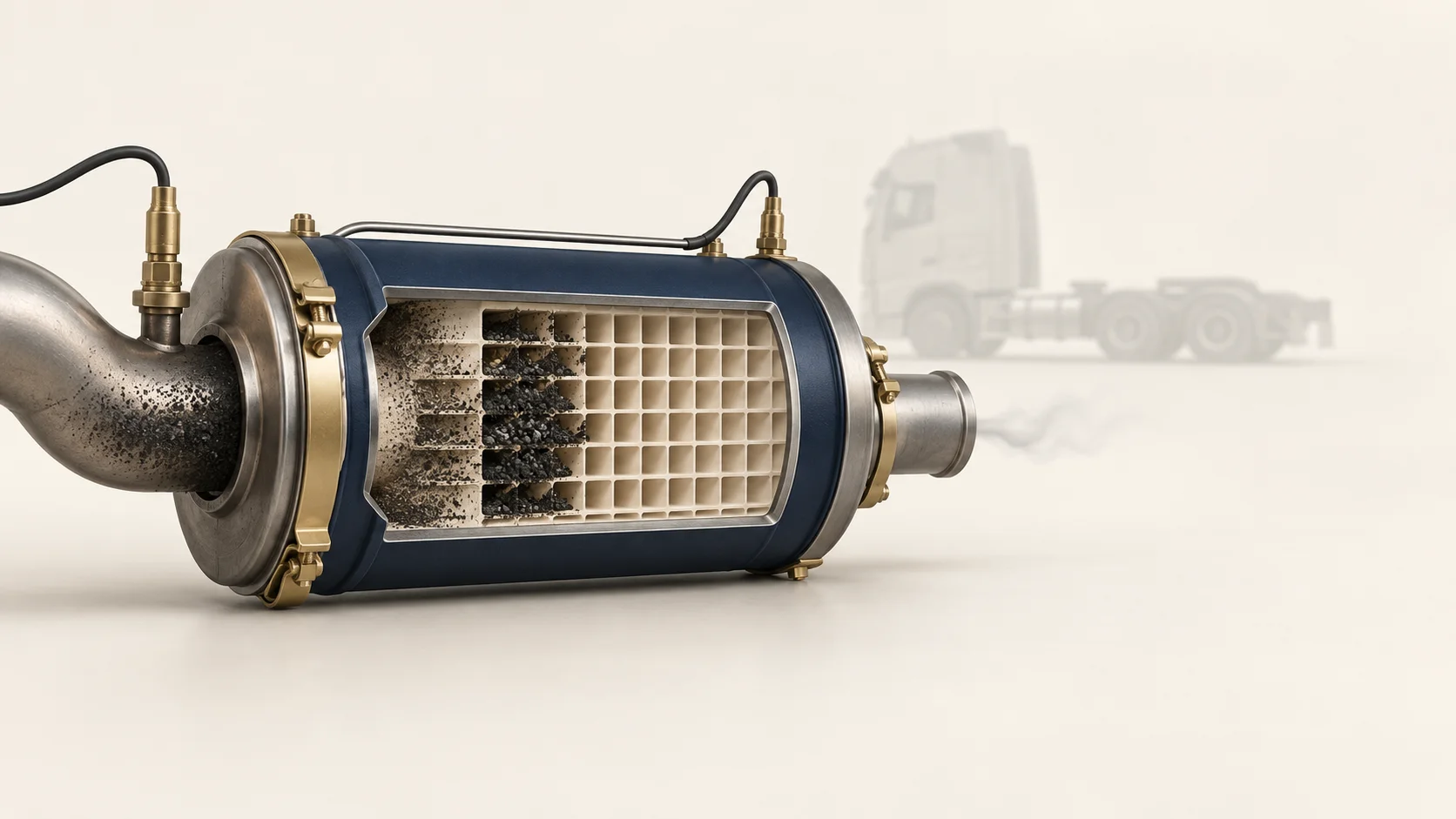
Soot can often burn away, but ash remains in the filter.
Short trips and long periods of low-load driving can hinder regeneration.
Do not force repeated regeneration if a warning light stays on.
Professional checks should cover fault codes, sensors, engine condition, and filter restriction.
What are the clearest signs of a clogged filter?
The clearest signs are a filter warning light, loss of power, repeated regeneration, higher fuel use, rough running, and cooling fans that run more often than usual. A vehicle may show one symptom or several at once.
The first signs can be easy to miss. A driver may notice that the engine feels less willing under load. A truck may take longer to gain speed, hold a lower gear, or struggle on a hill that caused no issue before.
Warning lights offer a more direct clue. Depending on the vehicle, the dashboard may show a filter symbol, an engine warning, or both. A message may also request a drive cycle or workshop visit. Check the owner's manual because symbols and required actions differ by make and model.
The UK government guidance on diesel particulate filters explains that short trips at low speeds can prevent the exhaust from reaching the conditions needed for regeneration. It also advises drivers not to ignore a warning light, since continued driving can lead to a more serious blockage.
What changes might you notice while driving?
You may feel slower throttle response, limited engine speed, weak pulling power, or a sudden move into reduced-power mode. These changes often become clearer during acceleration, towing, or climbing.
A restricted filter makes it harder for exhaust gas to pass through the system. The vehicle's control system may respond by limiting output. This protects key parts, but it also makes the vehicle feel heavy and slow.
Other possible signs include an unstable idle, a hotter smell after driving, and fans that continue running after the engine stops. Some of these can occur during a normal regeneration event. The key question is whether they happen once in a while or keep returning with other warnings.
What does repeated regeneration tell you?
Repeated regeneration suggests that soot is building up faster than the system can remove it, or that the regeneration process cannot finish. It does not prove that the filter itself has failed.
During regeneration, exhaust temperature rises so collected soot can burn. If a trip ends too soon, the cycle may stop before completion. The vehicle may try again later. Frequent interruptions can create a pattern of short, repeated cycles.
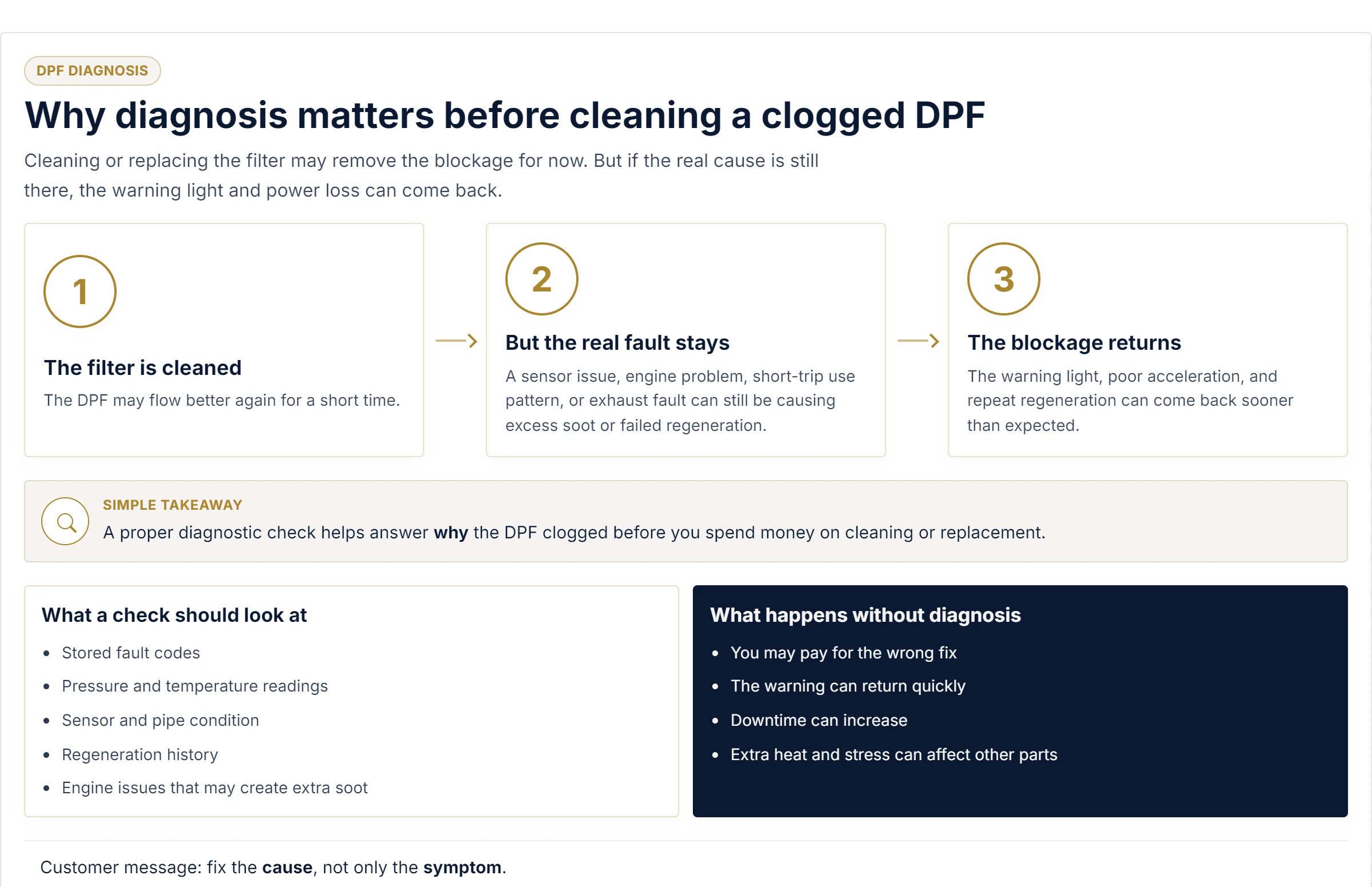
Engine or exhaust faults may also affect the process. A technician should read stored codes and review sensor data before blaming the filter. Replacing or cleaning a filter without finding the cause can lead to the same problem again.
Which symptoms need the fastest response?
A flashing warning light, severe power loss, several warning lights, or a vehicle that will not complete regeneration needs prompt attention. Stop and seek guidance if the vehicle manual tells you not to continue.
Do not keep driving simply to make a warning disappear. A normal drive-based regeneration is not the right response in every case. For example, an active engine fault or a heavily restricted filter may require workshop testing instead.
Common warning signs and likely next steps
What you notice | What it may mean | Sensible next step |
|---|---|---|
Filter light appears once | Soot load may be above the normal working range | Read the manual and follow the stated drive or service advice |
Light returns soon after regeneration | The cycle may not be finishing, or another fault may be present | Arrange a diagnostic scan and sensor checks |
Acceleration feels weak | Exhaust restriction may be rising | Avoid heavy work and book an inspection |
Fuel use rises with frequent regeneration | The system may be trying to burn soot too often | Check duty cycle, stored codes, and engine condition |
Reduced-power mode or several warning lights | The vehicle may have a serious restriction or related fault | Follow the manual and seek professional help promptly |
How do soot and ash affect the filter differently?
Soot is combustible material that regeneration can burn under suitable conditions. Ash is non-combustible residue, so regeneration does not remove it.
This difference is central to diagnosis. A temporary soot load may clear after a completed regeneration, if the vehicle has no related fault. By contrast, accumulated DPF ash stays within the filter channels and takes up space over time.
The US Environmental Protection Agency technical bulletin notes that diesel particulate filters need proper operation and maintenance, including the removal of accumulated ash. The service method and interval depend on the system and its application.
Regeneration is therefore not the same as full filter cleaning. It deals with soot. Professional off-vehicle cleaning may remove ash when the filter remains suitable for service. A damaged, melted, cracked, or contaminated unit may call for a different response after inspection.
What causes a temporary soot load?
A temporary load often follows short journeys, low-speed use, extended idling, or interrupted regeneration. The exhaust may not stay hot enough for long enough to complete the process.
This is common in vehicles that work hard in short bursts but spend much of the day moving slowly. Delivery vans, service vehicles, and trucks in stop-start traffic can face such conditions. Still, the driving pattern is only one part of the check.
If the warning clears after the correct procedure and does not return, the issue may have been temporary. If it returns quickly, treat that as useful evidence. Record the mileage, driving conditions, warning message, and any change in performance.
Why does ash create a longer-term restriction?
Ash cannot burn during regeneration, so it slowly reduces the filter's available capacity. Once enough ash is present, ordinary driving cannot restore that lost space.
Professional assessment can help separate ash loading from soot loading. Useful evidence may include service history, pressure readings, fault codes, mileage, engine condition, and the result of a controlled inspection. No single dashboard message can explain all of those factors.
This is why repeated forced regeneration is not a cure for every blockage. If ash is the main issue, extra regeneration adds heat but does not remove the residue.
How can you tell whether the restriction is temporary or serious?
A temporary restriction usually improves after one correctly completed regeneration and does not return soon. A serious restriction tends to persist, return quickly, or appear with power loss, fault codes, and failed regeneration attempts.
The pattern matters more than one isolated symptom. A hot smell and running fan during a single regeneration may be normal for that vehicle. The same signs every few trips, together with rising fuel use or warning lights, deserve investigation.
DPF clogging symptoms can overlap with fuel, air intake, turbocharger, exhaust, and sensor faults. A scan tool may show the system that detected a problem, but a fault code does not always identify the physical cause on its own.
What should you record before booking an inspection?
Record when the warning began, how the vehicle was being used, and whether regeneration finished. Clear notes can shorten diagnosis and reduce guesswork.
Write down every warning symbol and dashboard message.
Note whether the light is steady or flashing.
Record recent trip types, such as motorway, urban, idle-heavy, or towing work.
List recent repairs, oil changes, and exhaust work.
Note any rise in fuel use or drop in power.
Record the mileage between regeneration events, if the vehicle displays it.
Tell the technician if the engine uses oil or coolant.
Photos of dashboard messages can also help. Do not erase codes before a technician reads them unless the vehicle maker's guidance tells you to do so. Stored data may explain when and how the issue began.
Temporary and serious restriction compared
Clue | Possible temporary soot load | Possible serious restriction |
|---|---|---|
Warning light | Clears after the stated regeneration process | Stays on, flashes, or returns soon |
Vehicle power | Little or no lasting change | Clear loss of power or reduced-power mode |
Regeneration | Completes once and normal use resumes | Fails, stops repeatedly, or occurs very often |
Likely material | Manageable soot loading | Heavy soot, ash, contamination, or filter damage |
Next action | Monitor and follow vehicle guidance | Arrange testing before further regeneration attempts |
When is professional inspection necessary?
Professional inspection is necessary when a warning stays on, returns after regeneration, or appears with poor performance. It is also wise when the vehicle enters reduced-power mode or has related engine faults.
A proper inspection should look beyond the filter shell. The technician may review stored codes, exhaust pressure information, temperature data, service history, and regeneration records. The engine should also be checked for conditions that may create excess soot or interfere with exhaust temperature.
The phrase DPF abnormality can refer to several issues, not just a blocked core. A damaged pressure line, unreliable sensor, exhaust leak, failed heating process, or engine-side fault may produce similar dashboard warnings. Testing helps prevent an unnecessary filter change.
What should a diagnostic check include?
A useful check should confirm the warning, examine stored data, assess filter restriction, and look for the reason soot loading increased. The exact procedure depends on the vehicle and system.
Confirm the dashboard warning and driver report.
Read current, pending, and stored fault codes.
Review available pressure and temperature data.
Check whether recent regeneration attempts completed.
Inspect related hoses, lines, wiring, and visible exhaust parts.
Review engine faults that may raise soot output.
Decide whether regeneration, off-vehicle cleaning, repair, or replacement is suitable.
Vehicle owners and fleet teams can also review the company's recycling articles and updates for broader material recovery information.
Can driving habits reduce the risk of another blockage?
Yes. Trips that let the exhaust reach and hold the required operating condition can support normal regeneration, while frequent short or idle-heavy use may interrupt it.
Always follow the vehicle maker's instructions. Do not copy a drive cycle from another model. Required speed, engine load, safety steps, and warning responses can vary.
Plan suitable runs when the vehicle's normal work pattern involves only short journeys. Avoid switching off the engine during an active regeneration when it is safe and lawful to continue. Keep scheduled servicing up to date, and use the fluids stated by the vehicle maker.
Driving habits cannot fix every case of DPF clogging. If the filter contains too much ash, has physical damage, or receives excess soot due to an engine fault, a longer drive will not solve the root cause.
What should fleet managers track?
Fleet managers should track warnings, regeneration frequency, power complaints, duty cycles, and repeat repairs by vehicle. A simple record can reveal patterns before several vehicles lose service time.
Compare vehicles doing similar work. One unit that regenerates far more often than the rest may need attention. Driver reports should use clear terms, such as warning date, route type, load, power change, and whether the cycle completed.
For heavy commercial units, a truck DPF can be large and difficult to handle. Removal, storage, transport, assessment, and recycling should follow a controlled process. Legend Metal works with business customers that handle used vehicle exhaust components and recyclable materials in Japan.
What should happen to a removed filter?
A removed filter should be identified, stored safely, and assessed through a responsible route. It should not be treated as ordinary mixed waste.
Filters and related catalyst units may contain recoverable materials. Their condition, identity, and prior processing affect how they should be handled. Clear records also help businesses track material from collection through assessment and recycling.
Legend Metal serves repair shops, dismantlers, recyclers, suppliers, factories, and commercial vehicle businesses. Its business-focused approach includes data-led assessment, clear reporting, prompt handling, and traceable recycling routes for eligible used exhaust parts and other recyclable materials.
Summary
The main signs of a clogged DPF are warning lights, weak acceleration, reduced power, rising fuel use, and regeneration that happens too often or does not finish. Soot may clear through a correct regeneration process, but ash does not burn away. If symptoms remain or return, professional testing should check the filter, sensors, stored data, and engine condition.
Once a unit leaves service, careful identification and responsible recycling matter. Legend Metal supports business customers in Japan with transparent assessment and traceable recovery routes for used catalyst and exhaust components.